
A five-year career plan provides a clear direction, helping you make smarter decisions about the roles you pursue, the skills you develop, and the opportunities you accept.
Many professionals spend more time planning their next holiday than planning their next career move.
They apply for jobs as opportunities arise, accept promotions without considering long-term goals, and hope that experience alone will lead to career growth. While this approach may work for some, the most successful professionals are usually intentional about where they want to be and how they plan to get there.
A five-year career plan doesn't mean predicting every step of your future. Instead, it provides a clear direction, helping you make smarter decisions about the roles you pursue, the skills you develop, and the opportunities you accept.
Think of it as a roadmap. You may take different routes along the way, but knowing your destination makes it much easier to stay on course.
In this guide, we'll explore how to create a practical five-year career plan that keeps you focused, motivated, and prepared for future opportunities.
Why You Need a Career Plan
Without a clear direction, it's easy to become reactive rather than proactive.
You might:
Stay too long in a role with little growth.
Accept positions that don't align with your long-term goals.
Miss opportunities to develop valuable skills.
Fall behind as your industry evolves.
A career plan helps you make decisions with purpose.
It enables you to identify what you need to learn, who you should connect with, and which opportunities will move you closer to your goals.
Step 1: Define Your Long-Term Vision
Before planning the next five years, ask yourself an important question:
Where do I want my career to be five years from now?
Your answer doesn't need to be perfect, but it should provide direction.
Consider questions such as:
What role do I want to hold?
What type of company do I want to work for?
Do I want to become a specialist or a manager?
Which industries interest me most?
Do I want to work remotely, internationally, or start my own business?
What kind of lifestyle do I want my career to support?
The clearer your destination, the easier it becomes to identify the steps required to reach it.
Step 2: Assess Where You Are Today
Once you've identified your destination, evaluate your current position honestly.
Take inventory of your:
Skills
What technical and professional skills do you already possess?
Experience
What projects, responsibilities, and achievements have you accumulated?
Qualifications
What degrees, certifications, or licences do you have?
Strengths
What do colleagues consistently praise you for?
Weaknesses
Where do you need improvement?
This self-assessment highlights the gap between your current position and your future goals.
Step 3: Identify the Skills You'll Need
Every career path requires continuous learning.
Research job descriptions for your desired role and identify the qualifications employers consistently request.
For example:
Software Engineering
Cloud computing
System design
AI integration
DevOps
Cybersecurity
Leadership
Finance
Financial modelling
Risk management
Data analytics
Regulatory compliance
Marketing
Digital advertising
SEO
Analytics
Content strategy
Marketing automation
Healthcare
Advanced clinical certifications
Leadership
Digital health technologies
Create a learning plan that closes these skill gaps over time.
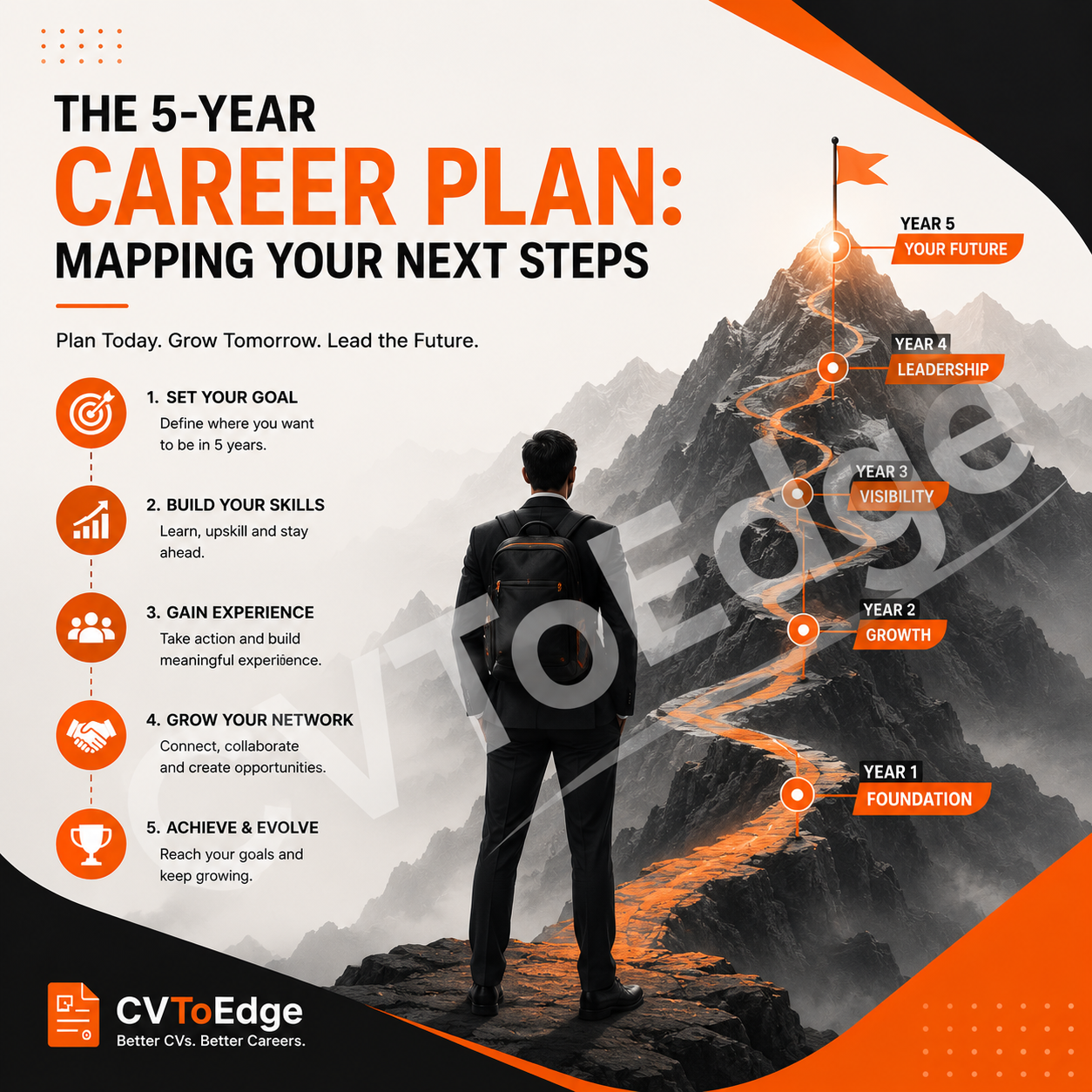
Step 4: Break Your Goal into Annual Milestones
Five years can feel overwhelming.
Breaking your vision into yearly objectives makes it much more manageable.
Year One
Focus on building foundational skills.
Examples:
Complete a professional certification.
Improve your CV.
Build your LinkedIn profile.
Attend networking events.
Year Two
Gain broader experience.
Examples:
Lead a project.
Learn a new technical skill.
Expand your professional network.
Year Three
Increase your visibility.
Examples:
Present at industry events.
Mentor junior colleagues.
Publish articles.
Earn another certification.
Year Four
Prepare for leadership or specialization.
Examples:
Apply for senior roles.
Manage a team.
Lead strategic initiatives.
Year Five
Reach your target position or transition into your desired career path.
Smaller milestones make long-term goals achievable.
Step 5: Build a Continuous Learning Plan
Industries evolve quickly.
Professionals who stop learning often fall behind.
Plan to invest in yourself regularly through:
Professional certifications
Online courses
Industry conferences
Workshops
Books
Podcasts
Mentorship
Practical projects
Continuous learning keeps your skills relevant and your career moving forward.
Step 6: Build Your Professional Network
Career growth is rarely achieved alone.
Relationships often create opportunities that qualifications alone cannot.
Invest time in building meaningful professional connections.
Network with:
Colleagues
Industry professionals
Recruiters
Mentors
Alumni
Professional associations
Strong networks provide:
Career advice
Job referrals
Learning opportunities
Partnerships
Mentorship
Networking should become a long-term habit, not just something you do when looking for a new job.
Step 7: Develop Your Personal Brand
Your reputation plays an increasingly important role in career advancement.
Employers often research candidates online before scheduling interviews.
Strengthen your personal brand by:
Maintaining an updated LinkedIn profile.
Sharing industry insights.
Building a professional portfolio.
Speaking at events.
Writing articles.
Participating in professional communities.
A strong personal brand increases your visibility and credibility.
Step 8: Track Your Achievements
Many professionals forget their accomplishments until it's time to update their CV.
Instead, maintain an ongoing record of your achievements.
Document:
Successful projects
Promotions
Awards
Revenue generated
Cost savings
Performance improvements
Leadership experiences
Customer feedback
Keeping this information updated makes future CV writing and interview preparation much easier.
Step 9: Review Your Plan Every Year
Your goals may change.
New opportunities may emerge.
Industries may evolve.
That's perfectly normal.
Review your career plan at least once a year and ask:
Am I moving in the right direction?
Have my goals changed?
Which new skills have become important?
What opportunities should I pursue next?
Treat your career plan as a living document rather than a fixed destination.
Step 10: Stay Flexible
Planning is important, but flexibility is equally valuable.
Unexpected opportunities often lead to career breakthroughs.
You may discover:
A new industry.
A leadership opportunity.
An international role.
A business idea.
A passion you hadn't previously considered.
Remain open to opportunities that align with your long-term vision, even if they weren't part of your original plan.
Common Career Planning Mistakes
Avoid these common pitfalls.
Having No Clear Goal
Without direction, progress becomes difficult to measure.
Ignoring Skill Development
Experience alone is no longer enough in today's competitive job market.
Waiting for Opportunities
Don't wait for promotions or learning opportunities to come to you.
Actively pursue them.
Neglecting Networking
Your professional network can open doors that online applications cannot.
Failing to Measure Progress
Review your goals regularly and celebrate milestones along the way.
Your 5-Year Career Planning Checklist
Before finalising your plan, ask yourself:
✔ Do I know where I want to be in five years?
✔ Have I identified the skills I need?
✔ Do I have annual milestones?
✔ Am I investing in continuous learning?
✔ Am I building a strong professional network?
✔ Is my personal brand aligned with my career goals?
✔ Do I regularly document my achievements?
✔ Have I scheduled time to review my progress?
If you can answer "yes" to these questions, you've built a solid foundation for long-term career success.
Final Thoughts
A successful career rarely happens by chance. It is built through consistent learning, thoughtful decision-making, and a clear sense of direction.
A five-year career plan gives you more than a list of goals—it provides a framework for making better choices every day. Each certification you earn, each project you complete, each relationship you build, and each new skill you develop becomes another step toward the professional future you envision.
Remember, your plan doesn't have to be perfect. It simply needs to give you direction while allowing room to adapt as industries change and new opportunities arise.
As your career grows, your CV should grow with it. It should reflect not only where you've been, but also where you're capable of going. CVToEdge helps professionals create ATS-friendly, recruiter-ready CVs that showcase achievements, highlight career progression, and position them for the opportunities that align with their long-term goals. Whether you're planning your next move or mapping out the next five years, CVToEdge is here to help you present your best professional story. Register & Subscribe today.